Foundation repair in Meridianville, for the older houses on the 231 corridor
Meridianville sits between the city and the farm country, and its housing shows it: 1960s and 1970s ranches on slabs and crawl spaces along the older roads, newer subdivisions filling in behind them. The older houses have finished most of their settling and started on the problems that come after, and the inspection is tuned to tell the two apart.
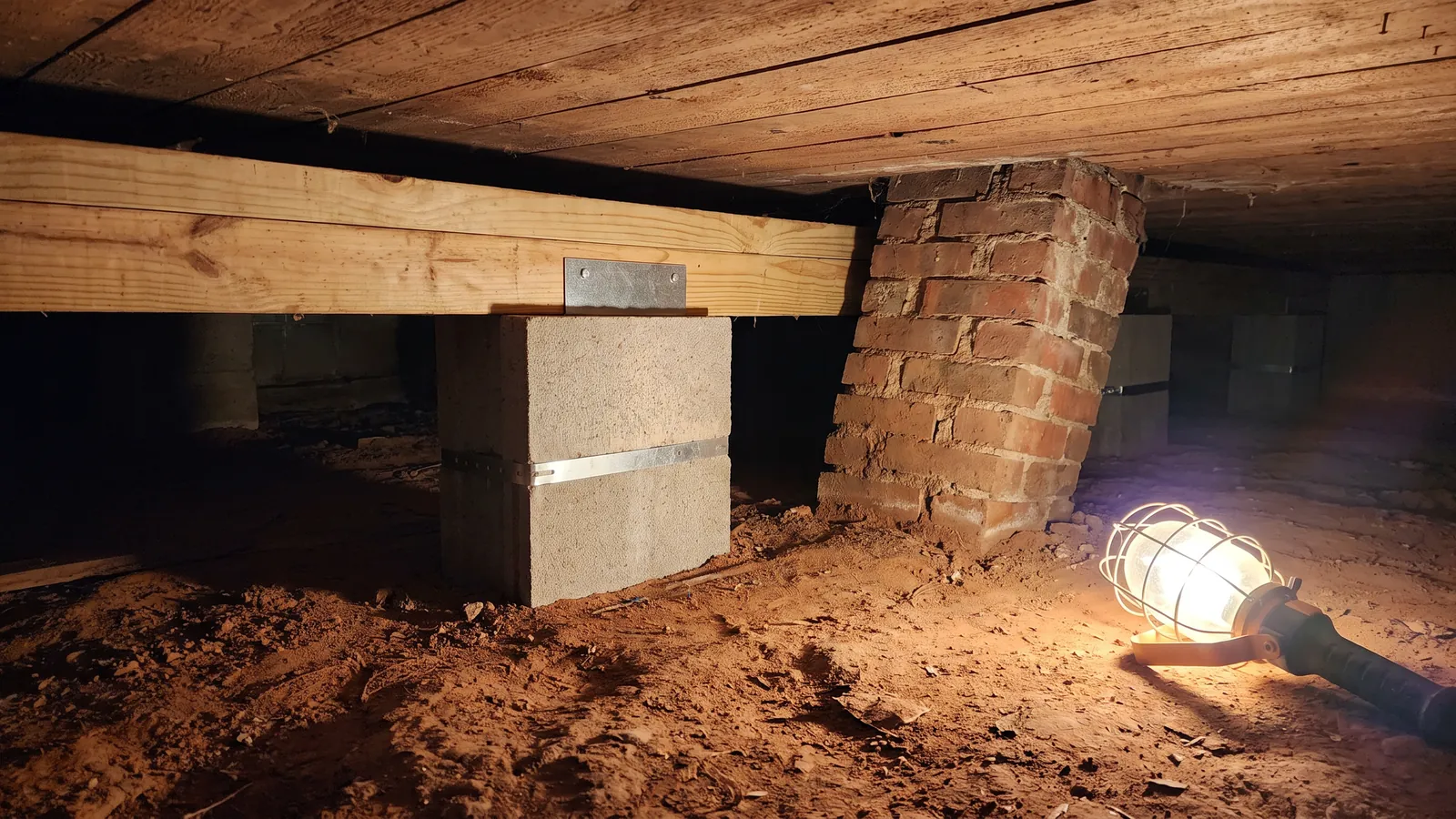
A house that has stood on Madison County clay for fifty years has already done most of the moving it is going to do. What we find in the older Meridianville ranches is not usually a slab still dropping; it is the slow damage of a half century of the same water hitting the same corner. Mortar joints opened in the 1980s and re-pointed, then opened again. A chimney that has leaned a few degrees and taken the flashing with it. A crawl space where the original block piers were set on the dirt and have leaned or sunk, and the girder sags between them so that the hall floor dips an inch at the bathroom door. Doors that were planed to fit forty years ago and still fit, which tells you the frame stopped racking long before you bought the house.
The inspection sorts the old from the new. Floor elevations on a laser show whether the low spots are the same ones that were trimmed to decades ago, in which case the house is stable and the floor is simply not level, or whether a corner has dropped recently, which shows as fresh hairlines above the old patches and trim that has pulled since the last paint. Cracks get gauged at both ends and dated. The yard is walked for the water: these lots were graded in an era before anyone extended a downspout, and most of them have four of them dumping at the footing.
The repairs on an older Meridianville house are often in the crawl space rather than under the slab edge. Leaning piers are replaced with piers on poured footings, the girder is raised with cribbing to a measured target, bathroom joists are sistered, and a vapor barrier goes down where the dirt stays damp. Where a slab corner has moved recently, push piers go in under the footing and lift it; where a chimney has leaned, it gets its own piers rather than being left to pull on the wall. Sealing comes last: re-pointing the stair-step cracks and injecting the slab cracks once the movement is done.
Meridianville is unincorporated, so structural permits are Madison County's; the crew files them and calls Alabama 811 before any digging. Pier jobs usually cross the $10,000 line for Alabama's residential home builder's licence, so the contractor's HBLB number is on the sheet. For the newer subdivisions on the east side of 231, the story is the Madison story instead, a slab in its first decade, and the inspection reads it that way; the page for Madison describes it.
How a Meridianville job runs
Old movement from new
Laser elevations compared against where the house was trimmed and shimmed decades ago, so a floor that is merely unlevel is not sold a pier.
Crawl space piers and girders
Block piers on dirt replaced with footed piers, girders raised with cribbing to a measured target, bathroom joists sistered.
Chimneys on their own piers
A leaning masonry chimney gets underpinned separately rather than left to pull the wall with it.
Sealing after the lift
Stair-step brick cracks re-pointed and slab cracks injected once the structure has stopped moving, so the patch holds.
Downspouts and grade
The four corners that have been wet since the 1970s dried out with extensions and regrading, priced on every sheet.
County permits, HBLB on the sheet
Madison County permits for underpinning, Alabama 811 locates, and the contractor's licence number for jobs of $10,000 or more.
Streets, subdivisions and landmarks we reach
- Older streets along Highway 231 and Moores Mill Road
- Neighborhoods off Steger Road and Winchester Road
- Subdivisions between Meridianville and Hazel Green
- Homes toward the Flint River on the east side
- The roads around Hazel Green High School's catchment south of town
What we repair in Meridianville
- Settled foundations put back on bearing with piers under slabs or new piers in the crawl space, and leveling to a measured target
- Cracks gauged and sealed with the right resin, bowing walls held with straps or anchors
- Basement waterproofing, sump pumps with battery backup, French drains and downspout work
- Crawl space encapsulation, free inspections before a purchase or after a storm, and commercial slabs
What Meridianville owners ask first
My 1968 ranch has an unlevel floor. Does it need leveling?
Not necessarily. Many houses that age settled in their first decade and were trimmed to fit; the floor is unlevel but stable. The inspection measures it and compares it with the old patches and shims. If nothing is moving, the honest advice is to leave it, and the report says so.
The chimney is pulling away from the house. What do you do?
A masonry chimney sits on its own footing and often settles on its own schedule. It gets its own piers and a lift back toward the house, then the flashing and the crack between chimney and wall are closed. Leaving it is how the roof starts leaking.
Is a crawl space job disruptive?
Not much. The crew works under the house for two to four days, you keep living in it, and the only sign inside is a floor that stops bouncing. Access is through the existing hatch; if there is not one, cutting one is on the sheet.
Who permits work in Meridianville?
Madison County, since Meridianville is unincorporated. Structural underpinning and lifting are permitted; drainage and vapor barrier work usually is not. The crew files it.
What about the new subdivisions on the east side?
Those are first-decade slab homes and behave like Madison's: an edge drops as the fill settles, and the question is whether it has finished. Same free inspection, same laser survey, and the sheet is priced to what the numbers show.
Also close by: Hazel Green · Harvest · Owens Cross Roads · every town we cover